In today’s digital world, staying ahead in SEO means understanding how people actually search. And one of the fastest-growing trends reshaping search behavior is voice search optimization. With the rise of smart speakers, voice assistants, and mobile voice searches, people are speaking more and typing less. This shift is changing the way we interact with content, and businesses that don’t optimize for voice search risk falling behind. So, if you want your content to be found easily, you need to make voice-friendly SEO a part of your digital strategy.
Unlike traditional searches, voice search tends to be more conversational, natural, and question-based. For instance, instead of typing “best Italian restaurants Mumbai,” a voice user might ask, “What are the best Italian restaurants near me in Mumbai right now?” That slight difference makes a huge impact on how search engines interpret and prioritize content. Therefore, understanding these nuances is crucial for creating content that answers such queries effectively.
What is Voice Search Optimization?
Voice search optimization simply means making your content more suitable and discoverable when people search using their voice instead of typing. When someone uses Google Assistant, Siri, or Alexa to ask a question, the answers they receive often come from content that is specifically optimized for voice queries.
This kind of optimization takes into account how people talk. It focuses more on how questions are asked out loud, rather than how they are typed. And because people usually expect fast, accurate, and easy-to-understand answers, your content must be written in a way that satisfies that demand.
For example, someone might type “pizza delivery Andheri” but say, “Which pizza delivery places are open near Andheri right now?” That change in query length and format is at the heart of voice search optimization.
Why Voice Search Optimization is Growing So Fast
There are a few big reasons why more and more people are using voice to search. First, it’s faster. Speaking is just easier than typing, especially when you’re busy, walking, driving, or cooking. Second, smartphones and smart speakers are now everywhere. Almost every household today has access to some kind of voice assistant.
Also, younger audiences are growing up using voice commands. Whether it’s asking Alexa to play a song or telling Siri to send a message, it’s now a habit. As these habits grow, so does the importance of making your content speak able and easy for search engines to understand.
Voice search is expected to make up a large percentage of all searches in the coming years, so ignoring it now means missing out on huge traffic opportunities later.
Why Voice Search Optimization Matters for Your Business
Let’s look at the bigger picture. When someone performs a voice search, they don’t get a long list of links. Usually, they hear one answer. That means your content either gets chosen or it doesn’t. There’s no second page.
So, if you run a business, blog, or even a service, being the top answer is crucial. And voice SEO gives you the tools to get there.
Also, many voice searches are local. People ask things like, “Where’s the nearest gym?” or “Is there a good coffee shop open right now?” So if you run a local business, voice search could help bring real, foot-traffic customers straight to your door.
In simple words, voice optimization boosts your visibility, improves user experience, and helps you stay ahead of the competition.
How Voice Search Optimization is Different from Typed Search
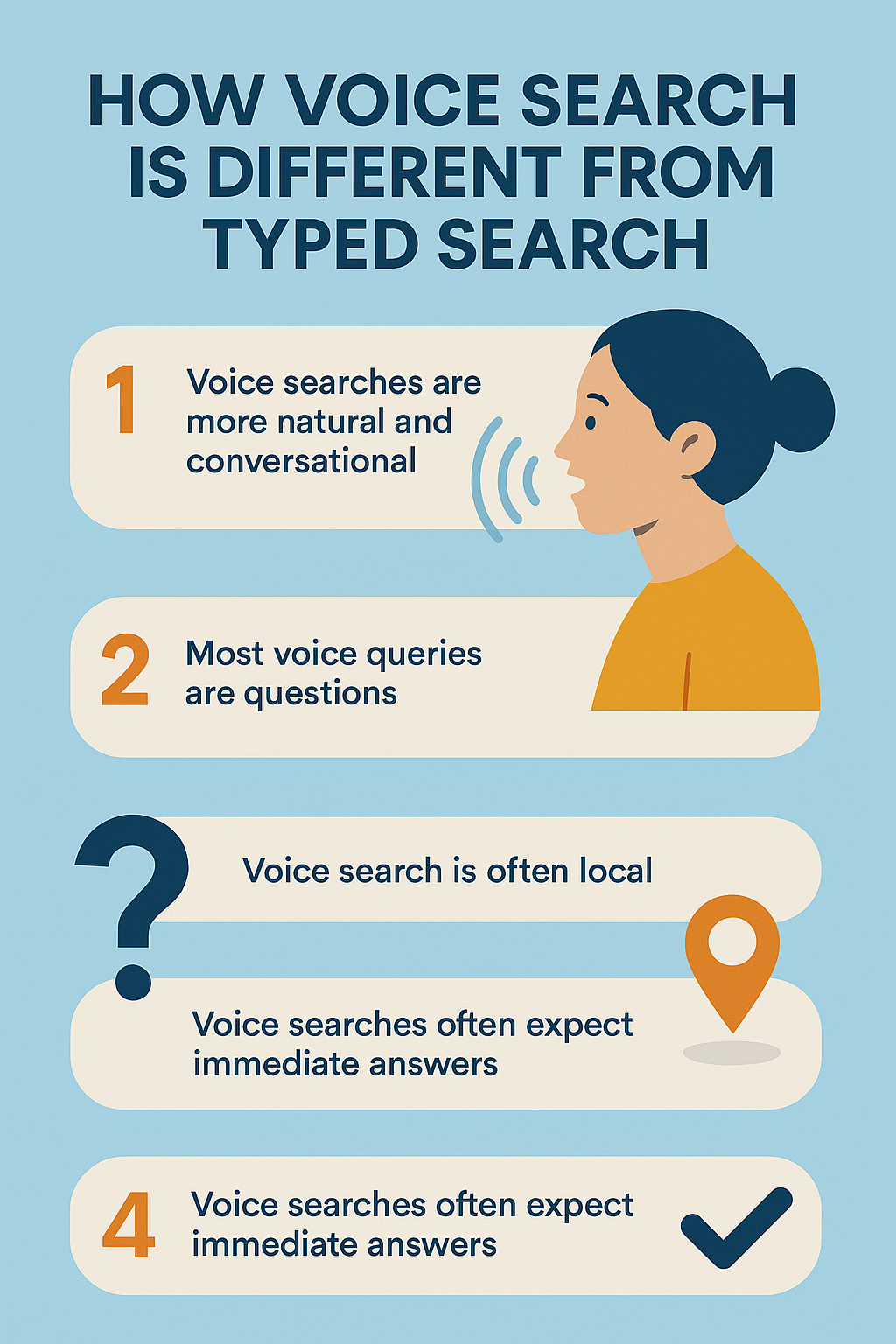
To make your content better for voice, you need to understand how voice searches are different from what people type. Here are some key points:
1. Voice Searches Optimization Are More Natural and Conversational
When we speak, we use full sentences and a more relaxed tone. For example, we might ask, “Can you find the best rooftop cafes in Bandra?” instead of typing “rooftop cafes Bandra.” That’s why your content should match this natural speaking style.
2. Most Voice Queries Are Questions
Unlike typed searches which are short and direct, voice searches often begin with question words like “what,” “how,” “where,” “can,” or “when.” So, if your content answers common questions in your niche, you have a higher chance of being chosen by a voice assistant.
3. Voice Search Optimization is Often Local
A large number of voice searches are made by people who are looking for something nearby. They might say, “Find a hair salon near me,” or “Is the nearest petrol pump open?” This means if you have a physical business, optimizing for local voice search can help you get noticed more easily.
4. Voice Searches Optimization Often Expect Immediate Answers
People using voice search are usually looking for quick, reliable answers. They want useful information without needing to scroll through multiple pages. That’s why your content must be well-structured and straight to the point.
Now let’s move on to how you can actually optimize your website and content for voice search.
Step-by-Step Guide to Optimizing for Voice Search
Optimization
Use Natural and Conversational Keywords
First, think about how people speak, not just how they type. Instead of short, keyword-heavy phrases, use longer, more natural phrases that reflect how someone would actually ask a question.
For example, instead of just “budget hotels Jaipur,” use “What are the best budget hotels to stay in Jaipur for families?”
To find such questions, tools like AnswerThePublic or even Google’s autocomplete feature can help you understand what people are really asking.
Create a Q&A Section
Because voice searches are mostly questions, having a section on your page where you answer common queries can really help.
Try to include real user questions and give simple, direct answers. This can also increase your chances of being picked for a Google Featured Snippet—the small answer box that shows up on top of search results.
Optimize for Featured Snippets
Featured Snippets are the short answers you often see at the top of search results, and they are often used for voice responses. To get your content into these:
- Start answers immediately under headings.
- Use clean formatting like bullet points or tables when possible.
- Keep answers short and to the point (40-50 words).
Focus on Local SEO
Make sure your business appears when someone nearby is asking for services you provide. Here’s how:
- Update your Google Business Profile.
- Include your address, phone number, and working hours on your site.
- Use local keywords like “best bakery in Bandra” or “yoga class near Andheri.”
Also, encourage your customers to leave reviews. The more positive reviews you have, the more likely Google is to recommend you.
Improve Website Speed and Mobile Experience
Since most voice searches happen on mobile, your site needs to load fast and work well on phones.
Use tools like Google PageSpeed Insights to check how your website is doing. Compress large images, clean unnecessary code, and avoid pop-ups that make it hard to navigate on a small screen.
Also, make sure your font is readable, buttons are easy to tap, and the layout looks clean.
Use Schema Markup
Schema markup is a type of code that tells search engines more about your content. It helps them understand the topic, purpose, and structure of your page.
Using schema properly can help you appear in rich results and increase your chances of being picked for voice answers.
There are many types of schema like FAQ schema, article schema, or local business schema. You can generate these using Google’s Structured Data Markup Helper.
Write for Humans, Not Just for Search Engines
Even if you follow all technical tips, if your content isn’t useful or interesting, people will not stay.
Make sure your writing is simple, engaging, and easy to understand. Avoid complicated words. Use everyday language. Keep your sentences short and your tone friendly.
The goal is to sound like you’re talking directly to the reader, just like a voice assistant would.
Include Voice Search Optimization in Your Content Strategy
You should start thinking about voice from the beginning. When planning your content, ask yourself:
- What questions might people ask related to this topic?
- Can I answer those questions in a clear and useful way?
- Does this content make sense when read aloud?
If you keep voice search in mind while creating blogs, landing pages, or product descriptions, your content will naturally become more accessible.
Monitor and Improve
Voice SEO is not a one-time task. You need to keep checking your performance.
Use tools like Google Search Console, SEMrush, or Ahrefs to track which pages are getting traffic from voice-like queries. Look for questions or long-tail keywords bringing visitors. Then update your content to answer those queries better.
Also, keep up with how voice technology is evolving. As Google and other companies release updates, adapt your strategy accordingly.
Conclusion
Voice search is not just another SEO trend. It’s a major shift in how people find information. As more users start speaking their queries, businesses that focus on voice search optimization will stay ahead.
From using natural keywords and answering real questions, to improving local SEO and site speed—every small step counts. So, if you want your content to be heard, not just seen, it’s time to take voice search seriously.
Start by understanding how your audience talks, what questions they ask, and how they use devices to get answers. Then, create helpful, easy-to-read content that sounds human.
Because in the world of voice search, sounding human is your biggest strength.
If you’re ready to grow, now’s the time to make your website voice-friendly.
And remember—make your content speak before someone else’s does.Guide on Email Automation
you can contact us on Whatsapp